Greening and recycling clothes pathways to flatten the carbon emission in China’s textile industry by 2035
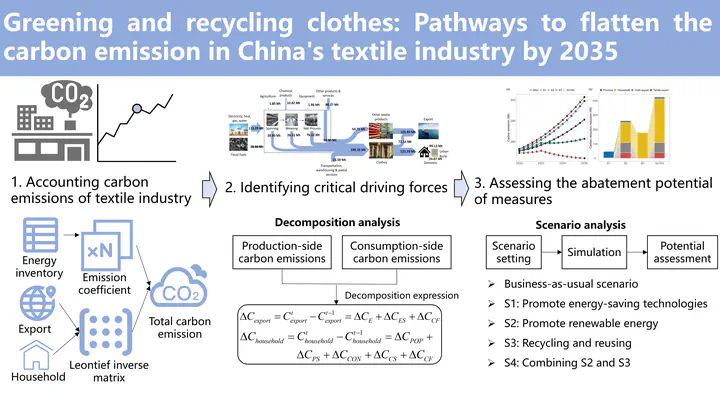 Image credit: Elsevier
Abstract
As economic growth drives lifestyle changes and increased fashion consumption, the environmental footprint of the textile and apparel industry has expanded significantly. A comprehensive understanding of carbon emissions from the textile and apparel industry and their underlying drivers is essential for designing effective mitigation strategies that align economic development with net-zero targets. Using household consumption data and supply chain data, we quantified total carbon emissions from China’s textile industry between 2000 and 2018, considering both production- and consumption-based perspectives. Results indicate that the growing demand contributes to 85% (79.5% to 92.7%) of total carbon emissions from China’s textile industry. The results of decomposition analysis further suggest that household consumption and exports together can lead to a total increase of 349.6 Mt CO2 in China’s textile industry from 2000 to 2018. To effectively curb the rapid increase in carbon emissions from the textile industry, we designed five scenarios to estimate the carbon reduction potential of measures such as the promotion of energy-saving technologies, adoption of renewable energy and enhanced clothing recycling. We found that a joint strategy combining renewable energy adoption and recycling can achieve significant reductions in total carbon emissions from China’s textile industry. These findings reveal the evolution process and drivers of carbon emissions in China’s textile industry, offering a scientific basis for achieving net-zero goals while sustaining the pursuit of high-quality development in the future.